Fear
Turns a falling price into an urgent need to sell, even when nothing about the business has changed. A falling price and a falling investment aren't the same thing.
Chapter 3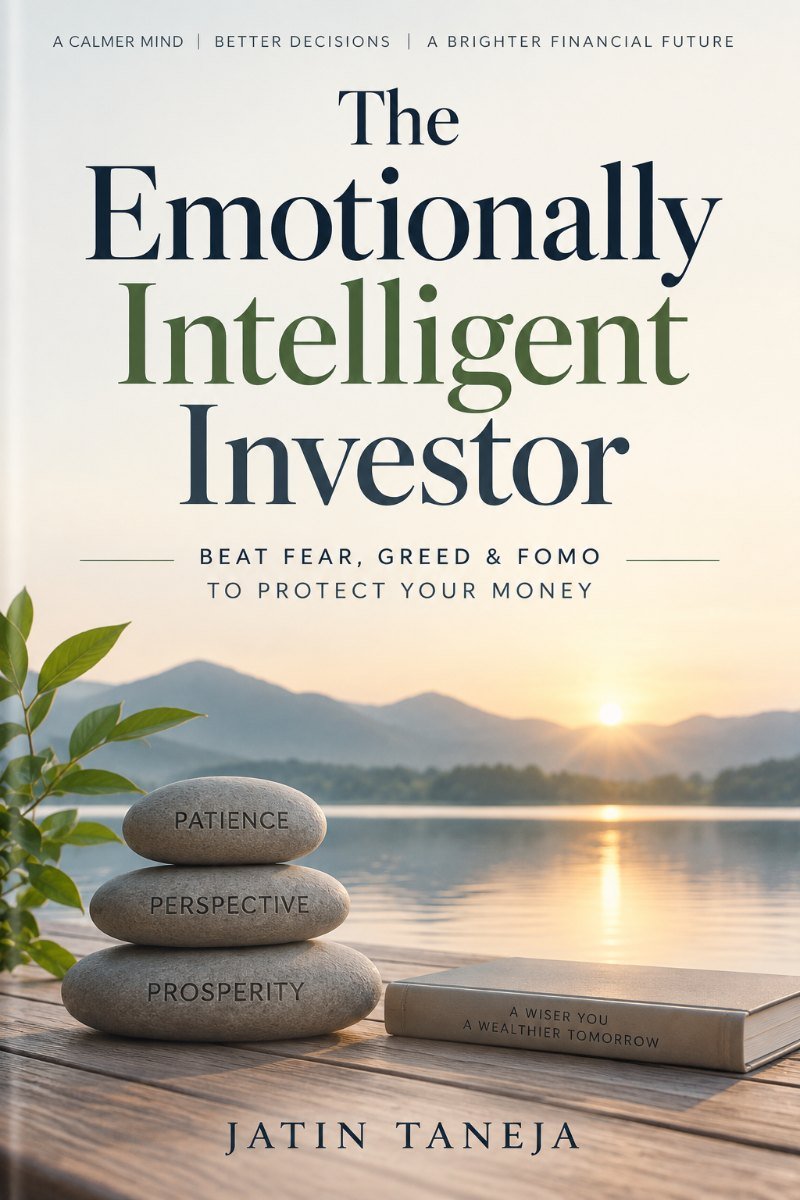
The Emotionally Intelligent Investor by Jatin Taneja
You can understand the fundamentals and still sell in a panic, chase a stock everyone is talking about, or hold a loser far too long. This complete 22-chapter guide explains how fear, greed, FOMO, overconfidence and crowd psychology shape investing decisions, and how to build a calmer process that holds up under pressure.
Most investors already know the rules. The difficulty is following them when a stock is falling, a friend is boasting about returns, or every notification says you're missing out. Those aren't knowledge problems. They're behaviour problems.
Turns a falling price into an urgent need to sell, even when nothing about the business has changed. A falling price and a falling investment aren't the same thing.
Chapter 3Rarely arrives as one reckless decision. It builds through small, reasonable-looking steps, until "enough" keeps moving further away.
Chapter 4Triggered by comparison, not by anything that happened in your own portfolio. It pushes you to buy because the opportunity feels like it's disappearing.
Chapter 5A few good results become "I'm good at this," and position sizes grow faster than the evidence behind them.
Chapter 9Following the crowd feels safer, because being wrong together hurts less than being wrong alone. It works the same way in rallies and in crashes.
Chapter 8Losses feel roughly twice as intense as equivalent gains, which is why investors so often hold losers and sell winners.
Chapter 6You will never stop feeling fear, greed or FOMO, and the book doesn't ask you to. Its goal is to create a pause between the feeling and the action, so the decision comes from your process instead of the loudest emotion in the room.
"An emotionally intelligent investor doesn't say 'I'm not afraid.' They say, 'I'm afraid — is there a rational reason for that?'"
From Chapter 1
KNOWLEDGEPROCESSSELF-AWARENESSCALM > REACTION
Sixteen things you'll be able to recognise, question and plan for. None of them depend on predicting the market.
The chapters build on each other: first the psychology, then real-world tests, then a system you build while calm so you can trust it when you're not.
Every chapter includes worked examples, exercises and key takeaways.
Five situations that test every investor. For each one, the book explores the emotional pressure involved and gives you a question to work through. It won't tell you what to buy or sell.
Everything is red, headlines are loud, and the urge to "just get out" is strong. How to tell broad volatility from genuine damage, and why checking prices less often helps.
The question that mattersHas anything about the businesses I own actually changed, or only the atmosphere around owning anything?
The market is calm but one holding isn't. A structured way to diagnose what changed, and why it isn't a binary choice between selling everything and buying more.
The question that mattersWould I buy this today, fresh, at this price?
A winner quietly grows into a large share of your portfolio. How to think about concentration, the fear of giving back gains, and why you don't need to sell at the top.
The question that mattersWhat explains the move: value, re-rating, or momentum?
Friends, family groups and social feeds make your steady returns feel small. How comparison works on the mind, and how to separate a real gap in your plan from envy.
The question that mattersAm I on track for my own "enough," regardless of anyone else's year?
When "never again" becomes the mood, the real danger is turning a temporary decline into a permanent retreat. How to tell caution from panic.
The question that mattersWould this still concern me if no one else was talking about it?
The later chapters turn insight into a system: documents and habits you create while calm, so they're ready when your emotions aren't.
A written plan for your money, prepared in advance: how you respond to declines and gains, a cash policy, and a fixed review schedule.
Why willpower is the wrong tool, and how to add friction before you override your own plan.
Rules built from your own trading history and recurring mistakes, not generic advice. You revise it whenever new evidence arrives.
Record your reasoning before you know the outcome, so memory can't quietly rewrite what you were thinking.
A five-step decision sequence that tells you which tool to reach for, and when.
The whole book compressed into ten rules, each linked back to the chapter it came from, with an exercise to rewrite them in your own words.
Each chapter shows its ideas in practice through Sam's decisions: the panic sale, the stock bought because everyone was talking about it, the winner that grew too large, and the slow, uneven progress towards a system he can trust.
Sam is fictional. He is a composite investor created to illustrate the concepts in the book. He does not represent any real person, account or outcome.
Does the research, understands the business, feels confident.
Sells in fear, chases excitement, holds on to avoid admitting a mistake.
Starts to notice the pattern and name the emotion behind each decision.
Writes down his thesis and plan before the pressure arrives.
Builds a personal rules book from his own history and keeps a journal.
A framework he can follow with the feeling still in the room.
It won't tell you which stock to buy, when to sell, or where the market is headed next. It helps you notice your own reasoning at the moment it matters most.
A refreshing approach to investing. Instead of focusing only on numbers and charts, this book explains how emotions can influence our investment decisions. The examples made the concepts very easy to understand.
I’ve read several books about investing, but I found this one particularly relatable. It helped me understand why fear, greed, and impatience can lead to poor decisions. A great read for beginners.
The book explains emotional discipline in investing without making it complicated. I especially liked the practical examples and simple language.
What I liked most is that the book doesn’t just tell you what to do—it makes you think about your own behavior as an investor. Very useful for anyone starting their investing journey
Simple, practical and easy to follow. The sections on handling market volatility and avoiding emotional decisions were especially helpful.
A good reminder that successful investing is not only about finding good stocks, but also about managing yourself. I found the lessons highly practical.
Clean, carefully formatted chapters with tables, checklists, exercises and diagrams.
Tap a page to enlarge it.
Most investing content focuses on the market. This book focuses on the person making the investment decision.
A forecast asks an unanswerable question about the future. A rule asks an answerable question about you.
It's a digital ebook delivered as a downloadable PDF file.
After your payment is successful, you'll be redirected to a thank-you page with a "Download your ebook" button. Click it to download the book.
Immediately after successful payment, on the thank-you page.
Yes. It's written in plain language and starts with how your brain reacts to markets. It is also useful for experienced investors who understand the basics but find emotions getting in the way of their decisions.
No. The book does not tell you which stock to buy, when to sell, or where the market is headed. It focuses on investor psychology and on building your own decision-making process.
No. Investing involves risk, including possible loss of principal. The book aims to help you make more deliberate decisions. It does not promise any particular financial result.
No. The ebook is for educational and informational purposes only. For decisions about your own situation, please consult an appropriately qualified professional.
Payment is handled by our payment gateway. Once it's confirmed, the gateway redirects you to the thank-you page, where you'll find the download button for your ebook.
Yes. You can read it on a phone, tablet or computer using any standard PDF reader.
Please use our contact page. Include your payment reference if your question is about an order.
It's also about understanding the person making the decision.
Disclaimer: This ebook is provided for educational and informational purposes only. It does not constitute financial, investment, legal, accounting, or tax advice, and it is not a recommendation to buy, sell, or hold any security, asset, or investment strategy. Investing involves risk, including possible loss of principal. Readers should conduct their own research and consult an appropriately qualified professional regarding their individual circumstances.